For the first time, a state asked voters whether they wanted to take legal weed back. Massachusetts answered no, by roughly three to one.
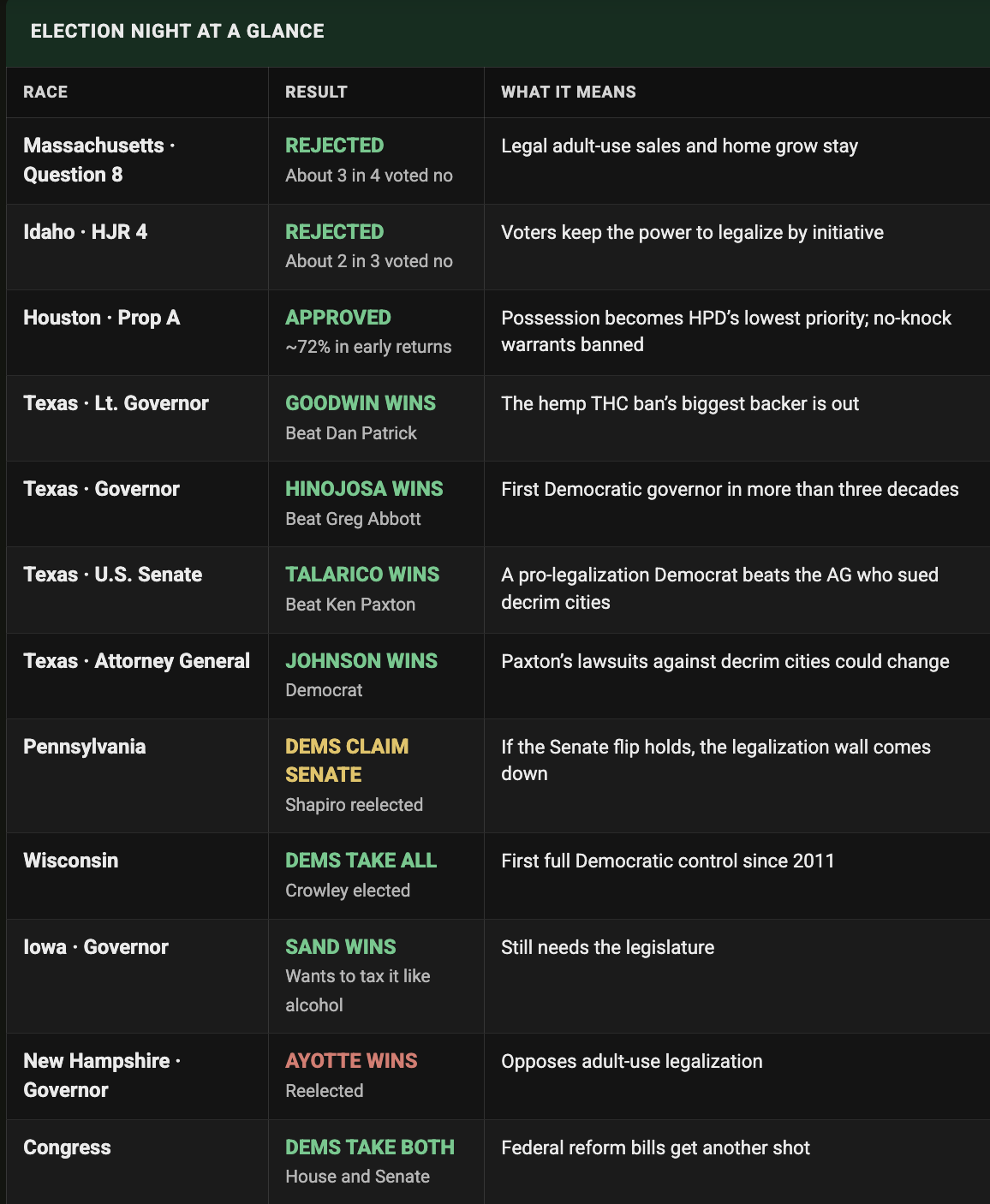
That was the headline cannabis result of Tuesday’s midterms, but it wasn’t the only one. Idaho voters rejected an amendment that would have stripped them of the power to legalize marijuana. Houston made possession its police department’s lowest priority. In Texas, Lt. Gov. Dan Patrick and Attorney General Ken Paxton both lost. And the list of states where legalization could advance next year got longer.
There was one exception. New Hampshire reelected a governor who wants to keep adult-use cannabis illegal.
The Ballot Measures
The Associated Press called Massachusetts Question 8 for No just before midnight Eastern. The measure would have repealed the laws that allow licensed adult-use sales and home growing, starting in 2028, while keeping the medical program and limited possession legal. Roughly three-quarters of voters said no in unofficial results.
The repeal campaign wasn’t cheap. Spending on Question 8 approached $6.5 million, making it the most expensive question on the state’s ballot, and SAM Action, the political arm of Smart Approaches to Marijuana, put in more than $3.7 million of it, according to CommonWealth Beacon. The state’s legal market, which the industry puts at about $1.65 billion a year, stays open.
“Despite a well-funded scare campaign, Massachusetts voters have chosen common sense by defeating the ballot initiative to end the state’s legal adult-use cannabis market,” Adam J. Smith, executive director of the Marijuana Policy Project, said in a statement.
SAM didn’t concede much. “Though we came up short tonight, this is a pyrrhic victory for the industry and we are not backing down—Maine and other states will be next,” Kevin Sabet, SAM Action’s president and CEO, said in a statement.
In Idaho, lawmakers had asked voters to amend the state constitution so that only the legislature could legalize marijuana or any other psychoactive substance. That would have ended citizen initiatives on the issue for good. About two-thirds of voters rejected it, according to unofficial results, and AP called the race.
Weed stays illegal in Idaho, including for patients. But the door that advocates tried and failed to walk through this year, with a medical cannabis petition that came up short on signatures, stays open.
Who Could Legalize Next
The most consequential results for legalization may have come in state legislatures.
In Pennsylvania, the House has already passed a legalization bill, and Gov. Josh Shapiro, who won reelection, keeps putting legalization in his budget. The Republican-led state Senate was the wall. Democrats now say they’ve flipped it for the first time in more than three decades, though some races were still being counted Wednesday. If that holds, Democrats will control the governor’s office and both chambers for the first time since 1993, according to The Philadelphia Inquirer.